Bylaw 14669
Amendment No. 838
WHEREAS SW 25-53-24-4; Block OT, Plan 8822879; Lot A, Plan 842 2557 and a portion of Lot S, Plan 922 1245, located south of 144 Avenue NW and east of Manning Drive NW, Clareview Business Park, Edmonton, Alberta, are specified on the Zoning Map as (AGU) Urban Reserve Zone; and
WHEREAS an application was made to rezone the above described property to (DC1) Direct Development Control Provision and (AP) Public Parks Zone;
NOW THEREFORE after due compliance with the relevant provisions of the Municipal Government Act RSA 2000, ch. M-26, as amended, the Municipal Council of the City of Edmonton duly assembled enacts as follows:
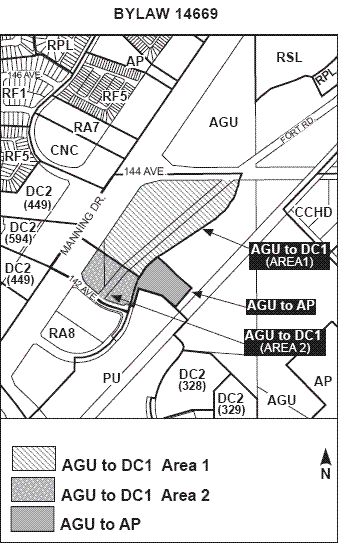
1. The Zoning Map, being Part III to Bylaw 12800 The Edmonton Zoning Bylaw is hereby amended by rezoning the lands legally described as SW 25-53-24-4; Block OT, Plan 8822879; Lot A, Plan 842 2557 and a portion of Lot S, Plan 922 1245, located south of 144 Avenue NW and east of Manning Drive NW, Clareview Business Park, Edmonton, Alberta, which lands are shown on the sketch plan annexed hereto as Schedule ”A”, from (AGU) Urban Reserve Zone to (DC1) Direct Development Control Provision and (AP) Public Parks Zone.
2. The uses and regulations of the aforementioned DC1 Provision are annexed hereto as Schedule ”B”.
SCHEDULE ”A”
SCHEDULE ”B”
(DC1) DIRECT DEVELOPMENT CONTROL PROVISION
(AREA 1)
Lands (4.5 ha) bounded by the Manning Freeway on the west, 144 Avenue on the north, spine road on the east, and the commercial site north of 142 Avenue on the south, designated as DC1 (Area 1) as shown on Schedule ”A” adopting this bylaw.
To accommodate transit oriented development consisting of low rise apartments that create a livable, mixed use ”urban village” environment and generates an improved sense of place and quality development through the use of urban design guidelines near the Clareview LRT Station.
a. Apartment Housing
b. Boarding and Lodging Houses
c. Minor Home Based Business
d. Child Care Services (limited to the ground floor of the building)
e. Residential Sales Centre
f. Fascia On-premises Signs
g. Projecting On-premises Signs
h. Freestanding On-premises Signs
i. Temporary On-premises Signs
a. The overall Site development shall be in accordance with the urban design criteria established herein.
b. The maximum Density shall be 125 Dwellings / ha.
c. The minimum Site Area shall be 800 m2.
d. The minimum Front Yard shall be 6.0 m adjacent to the spine road.
e. The minimum Rear Yard shall be 7.5 m adjacent to Manning Drive.
f. The maximum Height shall not exceed 14.0 m or 4 storeys. Floor Area may be developed in attic areas as additional space to a Dwelling, and not counted as a Storey, provided the additional Floor Area creates architectural interest to the design of the building and the development is within the maximum allowable Height.
g. The maximum Floor Area Ratio shall be 1.3 for Apartment Housing. The maximum Floor Area Ratio may be increased to 1.4 when underground parking is provided.
h. Separation Space shall be provided in accordance with Section 48 of the Zoning Bylaw.
i. A minimum Amenity Area of 7.5 m2 per Dwelling shall be provided for Apartment Housing.
j. Signs shall comply with the regulations found in Schedule 59H of the Zoning Bylaw
k. To ensure a high standard of development, building design plans shall be submitted with a Development Permit application. Such plans shall be to the satisfaction of the Development Officer and shall include details of overall site layout, exterior building treatment and colour scheme, perimeter and internal landscaping, fencing and screening, and surface vehicular parking layout.
l. Development applications shall be submitted to the City of Edmonton Design Review Committee for review and comment.
m. Landscaping shall be in accordance with Section 55 of the Zoning Bylaw.
n. Vehicular and bicycle parking shall be in accordance with Section 54 of the Zoning Bylaw.
o. Underground driveway ramps to a public roadway must be at grade at the property line and must not exceed a slope of 6% for a minimum distance of 4.5 m inside the property line or to the satisfaction of the Transportation Department.
a. Building Orientation and Site Planning
i The arrangement of buildings, parking and circulation areas, and open spaces should be responsive to site characteristics and relate to the surrounding built environment in pattern, function, scale, character and materials.
ii Building height and mass should be appropriate to the type and nature of adjoining development.
iii Buildings on corner and flanking lots, particularly at the intersection of Manning Drive and 144 Avenue, should be designed to be visually interesting and should be oriented towards the street to emphasize street presence and potential as a landmark within the community.
iv Clustering of multi-family units should be a consistent overall site-planning element and large projects should be broken up into groups of structures.
v Buildings should be oriented to promote privacy to the greatest extent possible.
vi Buildings should be sited to create courtyards and open space areas.
b. Site Entry and Edge Design
i Buildings shall address all adjacent public roadways, other than Lanes, with individual entrances that are clearly visible to lend a sense of occupancy to the street. Buildings on corner Sites should address both the street and avenue and shall distinguish the street intersection to give it prominence.
ii Where a Dwelling unit is provided at ground level abutting a public roadway, other than a Lane, the principal entrance to the unit shall have direct external access to the adjacent public sidewalk.
iii Low Rise Apartment uses should be distinguished by entry and edge design features such as ornamental landscaping, open space areas, natural features, use of architectural features and enhanced paving.
iv Primary entrance areas should be designed as defined architectural features of the building or complex. Entrances should also provide visibility to interior lobbies to aid in the safe and convenient arrival and departure from the building.
v Pedestrian entrances to parking and service areas within multi-family buildings should be considered in combination with other common areas that can provide casual surveillance opportunities.
vi Crime Prevention Through Environmental Design (CPTED) principles should be considered in the design of the site by providing pedestrian spaces that are well lit at night and active street frontages that provide opportunities for eyes on the street.
c. Vehicular Access / Circulation / Parking
i Site access and internal circulation should promote safety, efficiency and convenience. Conflicts between vehicles and pedestrians should be avoided. Continuous pedestrian circulation should be provided throughout the site to the greatest extent possible.
ii Adequate areas for maneuvering, stacking, and emergency vehicle access should be accommodated on site.
iii Site accesses should be minimized and located as far as possible from street intersections.
iv The principle off-street vehicle entrances for larger multi-family projects should use dedicated entry drives rather than the aisle of a parking area.
v Resident parking areas should be located underground wherever possible
vi No surface vehicular parking areas should be permitted abutting any public roadway other than Manning Drive.
vii Parking areas, when at grade, shall be regarded as important spaces whose character is clearly defined by landscaping, lighting, building massing, and pedestrian and vehicular circulation areas.
viii Adverse visual impacts on residential street character or the project from parking areas should be minimized through siting, landscaping and design.
ix Surface parking areas should be divided into a series of smaller connected lots to reduce the impact of overall mass and dominance of surface parking areas.
x Bicycle parking should be located close to, and with direct access to residential buildings.
d. Pedestrian Circulation
i Site design should facilitate safe pedestrian access and circulation in and around multi-family development. The primary street entrance should incorporate sidewalks on both sides to facilitate access and safety.
ii On site pedestrian walkways should be separated from auto circulation routes and be a minimum 1.2 metres wide, accessible, safe, visually attractive and well defined by decorative landscaping and lights. Use of changes in grade, materials, textures or colours are encouraged to delineate pedestrian crossings for improved visibility and safety.
iii Pedestrian walkways should be provided to link units with common amenity space, parking areas and the street and LRT station. Curvilinear walkways are encouraged for added site interest.
e. Amenity / Open Space
i The design and orientation of amenity / open space areas should provide shelter from noise and traffic from adjacent uses or streets.
ii Amenity / open space shall be appropriately designed for a range of passive and active recreational and social interaction opportunities (plazas, children’s play equipment, landscaped gardens, etc.) as well as user safety and long-term maintenance.
iii Amenity / open space areas shall be accessible to all residents and be provided in usable sizes and not fragments.
f. Utility and Mechanical Equipment
i All mechanical equipment, including roof mechanical units, should be concealed by screening in a manner compatible with the architectural character of the building or concealed by incorporating it within the building.
g. Trash and Storage Area
i Loading, storage, and trash collection areas should be located in such a manner to be screened from view from adjacent sites, public roadways, and Light Rail Transit line, in accordance with the provisions of Section 55 of the Zoning Bylaw.
ii Trash and storage enclosures should be architecturally compatible with project design and be unobtrusive and conveniently accessible for trash collection.
h. Fences
i Fence / wall design should be enhanced and constructed of materials such as masonry, metal, wood, or a combination thereof. Street visibility should be maintained in order to support a vibrant street environment, safe pedestrian access, and overall pedestrian comfort within the Community Centre.
ii planting should be provided along street frontages to soften their appearance provided that it does not block the visual connection between public streets and buildings.
i. Paving
i Decorative paving should be incorporated into parking lot design, driveway entries, and pedestrian walkways (on private property only) to emphasize pedestrian crossings and safety.
ii Paving materials should complement the architectural design and can include the use of stamped concrete, stone, brick, pavers, exposed aggregate, or coloured concrete.
j. Lighting
i Parking areas and entry drives should be lighted to facilitate pedestrian movement and safety, especially where parking is located away from street view.
ii The type and location of parking area and building lighting should not glare directly onto adjoining property, streets or skyward.
iii Open spaces should be adequately lighted with pedestrian scaled, durable, low maintenance fixtures.
iv The design and location of light fixtures should complement the design of building facade.
a. The use of all exterior wall finish material for all Dwelling units should be of high quality and harmonious in materials and colours.
b. Architectural treatment of all facades of the building should create a unified building exterior but include visual variety and provide a sense of human scale at ground level. The building should include the following design elements to reduce the perceived mass and add architectural interest:
i articulation of the façade and a variety of building elevations
ii creation of architectural pattern
iii the use of recessions and projections such as porches, bay windows, and entrances features, and
iv the use of exterior wall finishing materials, predominantly comprised of muted colours, with strong colours limited to use of accents.
c. Monotonous building facades that lack human scale proportions, large expanses of flat wall plains, and tall building foundation walls that are exposed above ground shall be avoided.
d. Garages/car ports should be designed to minimize adverse visual impacts on the site and streetscape and should reflect the design, materials and colours of the principal buildings.
e. Building materials should be durable, require low maintenance, and relate a sense of quality and permanence.
f. Development in this Area should utilize infrastructure and building practices, and site designs, that reduce the consumption of water, energy, and materials.
6. Landscaping / Streetscaping Guidelines
a. Landscaping should define and accent building entrances and parking lots, define edges of various land uses, buffer neighboring properties, and screen parking and storage areas.
b. Parking lot landscaping should accent driveways, frame major circulation aisles and highlight pedestrian pathways.
c. Landscaping should consider the use of plant materials that provide colour throughout the year to enhance their appearance during the winter months.
d. Additional landscaping shall be provided on private property where the site abuts Manning Drive, to enhance the visual and environmental qualities of the development.
(DC1) DIRECT DEVELOPMENT CONTROL PROVISION
(AREA 2)
1. Area of Application
Neighbourhood commercial site (1.3 ha) bordered by the Manning Freeway to the west, a Low Rise Apartment site to the north and collector roadways to the east and south, designated as DC-1 (Area 2) as shown on Schedule ”A” adopting this bylaw.
2. Rationale
To accommodate transit oriented development consisting of neighbourhood commercial uses that contribute to a livable, mixed use ”urban village” and generate an improved sense of place and quality development through the use of urban design guidelines near the Clareview LRT Station.
3. Uses
a. Bars and Neighbourhood Pubs, for less than 100 occupants and 120 m² of Public Space
b. Child Care Services
c. Commercial Schools
d. Convenience Retail Stores
e. Drive-in Food Services
f. General Retail Stores, not to exceed 1,000m² in size
g. Bars
h. Health Services
i. Indoor Participant Recreation Services
j. Minor Amusement Establishments, as an accessory use to a restaurant
k. Minor Service Stations
l. Personal Service Shops
m. Professional, Financial and Office Support Services, including drive-through banks
n. Rapid Drive Through Vehicle Services
o. Residential Sales Centre
p. Restaurants, for less than 100 occupants and 120 m² of Public Space
q. Specialty Food Services, for less than 100 occupants and 120m² of Public Space
r. Veterinary Services
s. Fascia On-premises Signs
t. Freestanding On-premises Signs
u. Projecting On-premises Signs
4. Development Regulations
a. The maximum Floor Area of any individual business premises shall not exceed 1,000 m2.
b. The maximum site area shall be 2.0 ha
c. The maximum Floor Area Ratio shall be 1.0.
d. A minimum landscaped yard of 4.5 m shall be required where a Site abuts a public roadway other than a Lane.
e. A minimum Yard of 3.0 m shall be required where the Rear or Side Lot Line of the Site abuts the Lot Line of a Site in a Residential Zone.
f. No parking, loading, storage, trash collection, outdoor service or display area shall be permitted within a required Yard. Loading, storage and trash collection areas shall be located to the rear or sides of the principal building and shall be screened from view from any adjacent Sites, public roadways or Light Rail Transit lines in accordance with the provisions of subsection 55.4 of this Bylaw. If the rear of sides of a Site are used for parking, an outdoor service or display area or both, and abut a Residential Zone or a Lane serving a Residential Zone, such areas shall be screened in accordance with the provisions of subsection 55.4 of this Bylaw.
g. The maximum building height shall not exceed 10 m.
h. Signs shall comply with regulations found in 59D of the Zoning Bylaw. With the exception of Freestanding On-premises Signs more than 30 metres from residential developments, signs shall be oriented away from the abutting residential developments. Freestanding On-premises Signs shall be limited to one per site.
i. Landscaping shall be in accordance with Section 55 of the Zoning Bylaw.
j. Vehicular and bicycle parking shall be developed in accordance with Section 54 of the Zoning Bylaw.
k. The siting, access and traffic impact of a Rapid Drive-through Vehicle Service shall be to the satisfaction of the Development Officer in consultation with the Transportation Department to ensure that the development does not prejudice the safety and transportation functions of adjacent public roads. In addition, the siting and development of Rapid Drive-through Vehicle Services shall be based on the following criteria:
i any Rapid Drive-through Vehicle Service shall be located in such a way that bay doors and vehicular access within 30 metres of residential development are oriented away from said residential development;
ii any application for a development permit for a Rapid Drive-through Vehicle Service consisting of any automatic car wash shall be limited to a maximum of one bay and shall contain information regarding anticipated noise impacts of the development accompanied by a statement from a qualified professional engineer outlining any necessary noise attenuation measures. The Development Officer may require as conditions of development permit approval that the applicant provide the noise attenuation measure recommended in the noise impact statement or any measure recommended by the City Engineer based on the noise impact statement; and
iii All mechanical equipment associated with a Rapid Drive-through Vehicle Services shall be housed within an enclosed building.
l. Drive-in Food Services shall be developed in accordance with Section 72 of the Zoning Bylaw. The location of any accessory food pick-up window and circulation shall be provided to the satisfaction of the Development Officer in consultation with the Transportation Department. Landscape treatments and screening of drive aisles and parking shall be incorporated into the drive-in location to the satisfaction of the Development Officer.
i Where Drive-in Food Services, that may in the opinion of the Development Officer, create negative impacts such as noise, light or odours which may be noticeable on adjacent properties, and where the Site containing Drive-in Food Services is directly adjacent to Sites used or zoned for residential activities, the Development Officer may, at the Development Officer’s discretion, require that these potential impacts be minimized or negated. This may be achieved through a variety of measures including: Landscaping; berming or screening, which may exceed the requirements of Section 55 of this Bylaw; noise attenuation measures such as structural soundproofing; downward direction of all exterior lighting on to the proposed development; and any other measures as the Development Officer may deem appropriate.
5. Urban Design Regulations
a. Building Orientation and Transition
i The arrangement of buildings, parking and circulation areas, and open spaces shall be responsive to site characteristics and relate to the surrounding built environment in pattern, function, scale, character and materials.
ii Buildings should be oriented parallel to Clareview Station Drive and 142 Avenue.
iii Built form should primarily be oriented to the intersection of Clareview Station Drive and 142 Avenue to create a landmark corner.
iv Consistent landscaping treatment should be applied along Clareview Station Drive and 142 Avenue.
v All sides of the building, exposed to the public road right-of-way, shall be finished in a consistent and harmonious manner.
vi Crime Prevention Through Environmental Design (CPTED) principles should be considered in the design of the site by providing pedestrian spaces and parking areas.
b. Parking and Circulation
Parking and circulation should be developed with regard to the following:
i The layout of parking areas shall specifically address the interrelation of pedestrian, vehicular and bicycle circulation in order to provide continuous, direct pedestrian access with a minimum of driveway and drive aisle crossings. Remedial treatments such as raised pedestrian crossings, forecourts and landings, special paving, lights and bollards shall be provided at significant points of conflict;
ii Landscaped islands with raised curbs shall be used to define parking lot entrances, the ends of all parking aisles and the location and pattern of primary internal access drives, and to provide pedestrian refuge areas and walkways; and
iii Parking areas should be screened by locating them behind buildings or implementing enhanced landscaping measures.
c. Utility and Mechanical Equipment
i All mechanical equipment, including roof mechanical units, should be concealed by screening in a manner compatible with the architectural character of the building or concealed by incorporating it within the building.
d. Trash and Storage Area
i Loading, storage, and trash collection areas should be located in such a manner to be screened from view from adjacent sites, public roadways, and Light Rail Transit line, in accordance with the provisions of Section 55 of the Zoning Bylaw.
ii Trash and storage enclosures should be architecturally compatible with project design and be unobtrusive and conveniently accessible for trash collection.
6. Architectural Regulations
a. The finishing material for all development should be of high quality, consisting of glass and glazed window wall systems, brick, stone, architectural concrete, pre-cast coloured concrete, stucco panels (to a maximum of 15% of the buildings’ exterior surface areas), or pre-finished metal.
b. Mechanical equipment on the roof of any building shall be concealed by incorporating it within the building roof, or by screening it in a way that is consistent with the character and finishing of the building.
c. Appropriate lighting of the Commercial Site should be undertaken to provide security and add visual interest. Lighting should be directed away from the adjacent roadways and residential uses.
d. Development in this Area should utilize infrastructure and building practices, and site designs, that reduce the consumption of water, energy, and materials.
e. Rapid Drive-through Vehicle Services developments shall have a total number of bays not to exceed one for any given Site and all operations and mechanical equipment associated with this Use Class shall be located within an enclosed building.
f. Special architectural treatment should be used in the built form at the intersection of Clareview Station Drive and 142 Avenue.
g. Front entrances should be encouraged to be oriented to Clareview Station Drive and 142 Avenue, where possible, to create an active street frontage.
h. Ground floors of buildings should be transparent to enhance pedestrian engagement.